
Orbiting Carbon Observatory-2OCO-2
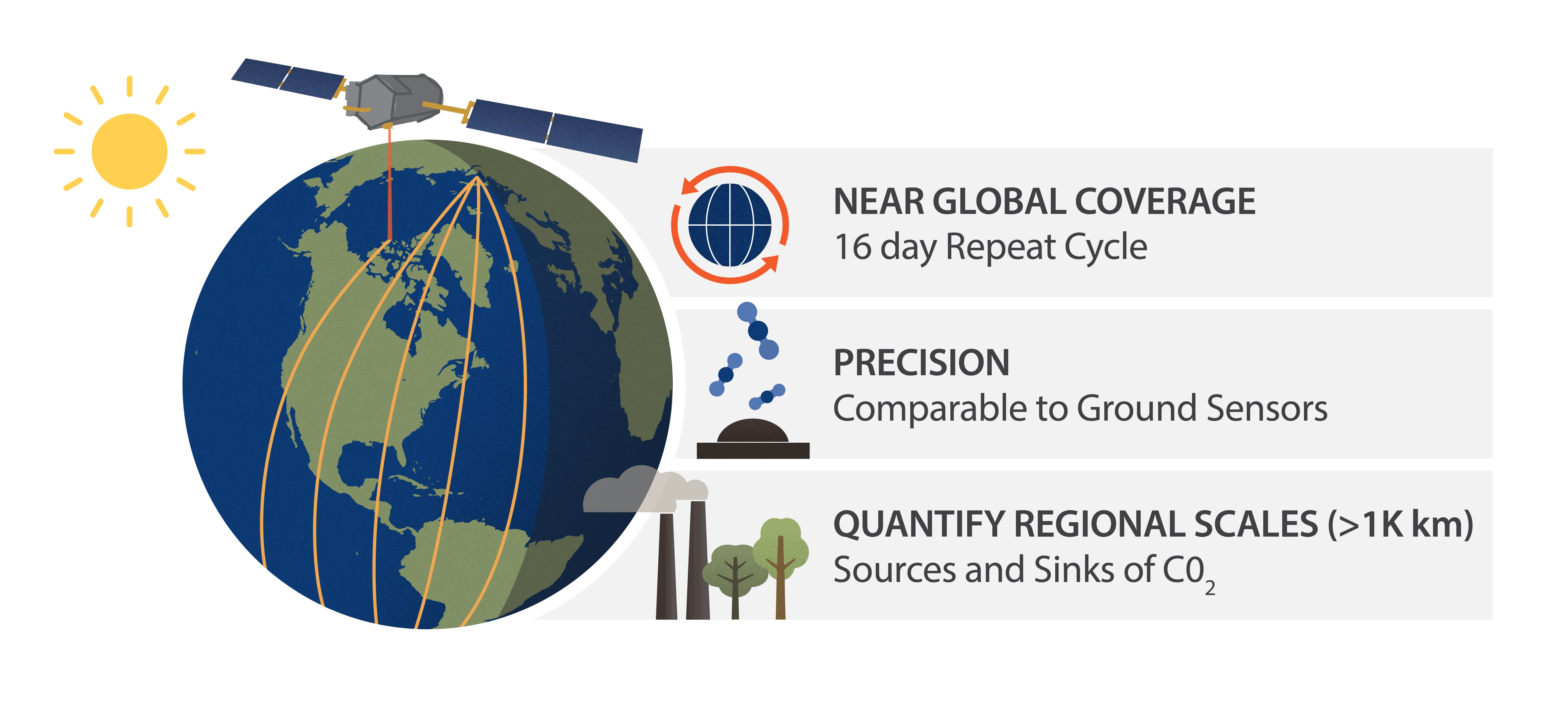
The OCO-2 Mission primary science objective is to collect the first space-based measurements of atmospheric carbon dioxide with the precision, resolution, and coverage needed to characterize its sources and sinks and quantify their variability over the seasonal cycle. OCO-2 flies in a sun-synchronous, near-polar orbit with a group of Earth-orbiting satellites with synergistic science objectives, whose ascending node crosses the equator near 13:30 hours Mean Local Time (MLT). Near-global coverage of the sunlit portion of Earth is provided in this orbit over a 16-day (233-revolution) repeat cycle. OCO-2’s single instrument incorporates three high-resolution grating spectrometers, designed to measure the near-infrared absorption of reflected sunlight by carbon dioxide and molecular oxygen.
Message One: OCO-2 is the gold-standard for monitoring the natural carbon cycle at multiple spatial and temporal scales, from local to regional to global and from seasonal to decadal.
Message Two: OCO-2 provides a long-term data record that enables monitoring of any potential emerging source-sink tipping points in the Earth System.
Message Three: OCO-2 is being used to quantify plant productivity and ecosystem health from farmlands to tropical and high-latitude forests.
Message Four: As a foundation for future missions and International collaboration, OCO-2 and OCO-3 serve as essential benchmarks and validation tools for upcoming satellite missions and are crucial for facilitating consistency across an international "virtual constellation" of missions.
- Retrieve estimates of the column-averaged carbon dioxide dry air mole fraction (XCO2) on regional scales (1,000 kilometers or greater) from space-based measurements of the absorption of reflected sunlight by atmospheric carbon dioxide and oxygen, collected in cloud-free scenes at least 80 percent of the range of latitudes on the sunlit hemisphere at monthly intervals for two years.
- Compare space-based and ground-based XCO2 retrievals from soundings collected during overflights of three or more primary ground validation sites at least once each season to identify and correct global-scale systematic biases in the space-based XCO2 product and to demonstrate a precision of 0.3 percent or less for collections of 100 or more cloud-free soundings.
- Record, validate, publish, and deliver science data records and calibrated geophysical data products to the Goddard Earth Sciences Data and Information Services Center for use by the scientific community.
- Validate a space-based measurement approach and analysis concept that could be used for future systematic carbon dioxide monitoring missions.
Point one: The burning of fossil fuels and other human activities are currently adding more than 36 billion tons of carbon dioxide to the atmosphere each year, producing an unprecedented buildup in this important greenhouse gas. OCO-2 data record is crucial for understanding the sources of carbon dioxide emissions and how they are changing over time.
Point two: Less than half of the carbon dioxide emitted into the atmosphere by human activities stays there. The location and identity of the natural “sinks” that are absorbing the rest of this carbon dioxide are currently not well understood. OCO-2 helps solve this critical scientific puzzle and helps us to understand and prepare for the future.
Point three: The innovative technologies incorporated into OCO-2 enable space-based measurements of carbon dioxide with the sensitivity, resolution, and coverage needed to understand human and natural sources of carbon dioxide emissions and the natural sinks that control its buildup, at regional scales, everywhere on Earth.
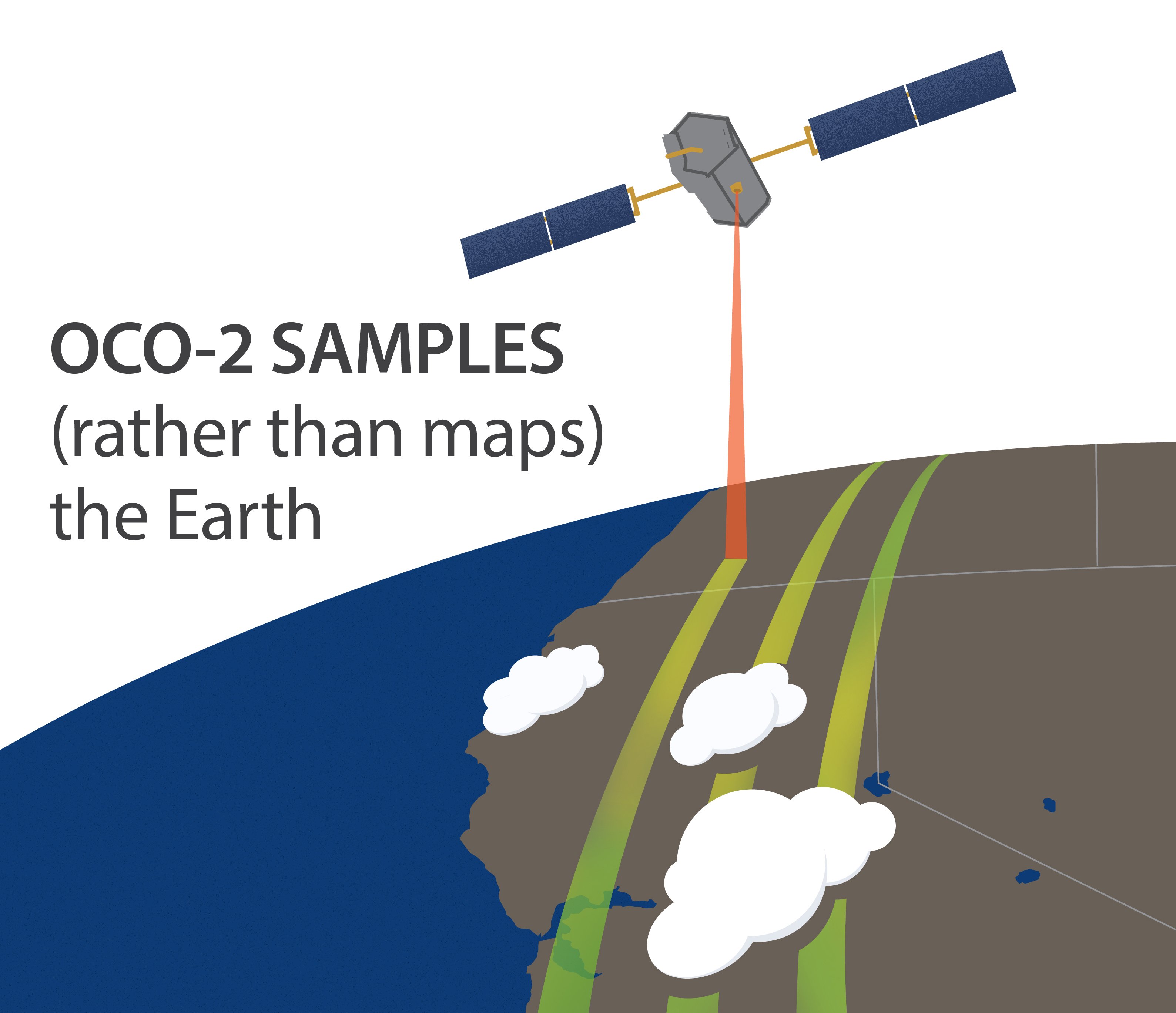
OCO-2 is an experimental mission that samples the Earth, collecting cloud-free, sun-lit measurements of CO2.