
Orbiting Carbon Observatory-2OCO-2
Since launching in 2014, OCO-2 has become widely regarded as the “Gold Standard” in column CO₂ measurements from space. As an unexpected bonus, OCO-2 also measures the faint “glow” emitted during photosynthesis, known as solar-induced chlorophyll fluorescence (SIF). It is a direct indicator of photosynthesis and ecosystem health.
OCO-2 provides the global coverage, spatial resolution, and accuracy needed to characterize and monitor the geographic distribution of CO₂ sources and sinks and quantify their variability.
The OCO missions measure atmospheric carbon dioxide (CO₂) and solar-induced chlorophyll fluorescence (SIF) from space, helping scientists study carbon sources and sinks, plant photosynthesis, vegetation stress, and changes in the global carbon cycle.
Natural source and sinks: The original science objectives of the OCO-2 mission were to collect the space-based measurements needed to quantify variations in the column averaged atmospheric carbon dioxide dry air mole fraction, XCO₂, with the precision, resolution, and coverage needed to improve our understanding of surface CO₂ sources and sinks (fluxes) on regional scales (≥1000km) and the processes controlling their variability over the seasonal cycle.
The OCO-2 mission has not only met but exceeded its original objectives, advancing our understanding of Earth’s carbon cycle across timescales from seasonal and interannual to decadal, and across spatial scales from urban and point sources to regional and global domains.
Monitoring ecosystem health with SIF: OCO-2 SIF measurements are being used to quantify and monitor plant productivity and ecosystem health from farmlands to tropical forests, showing great potential in predictions of drought, fires, and crop yield.
Benchmark upcoming satellite missions: The OCO-2 continues to serve as a pathfinder mission that demonstrates a space-based measurement approach and analysis concept that is being used to inform and benchmark the next generation of systematic CO₂ monitoring missions.
CO₂ is essential for life on Earth and plays a fundamental role in maintaining the atmosphere that protects our planet. At the same time, it is a major greenhouse gas, trapping heat that would otherwise escape to space and helping regulate Earth’s temperature.
Because of this dual role, changes in CO₂ concentration can disrupt the planet’s delicate radiative balance. In particular, rising atmospheric CO₂ levels are driving significant changes in the global climate, with far-reaching environmental consequences.
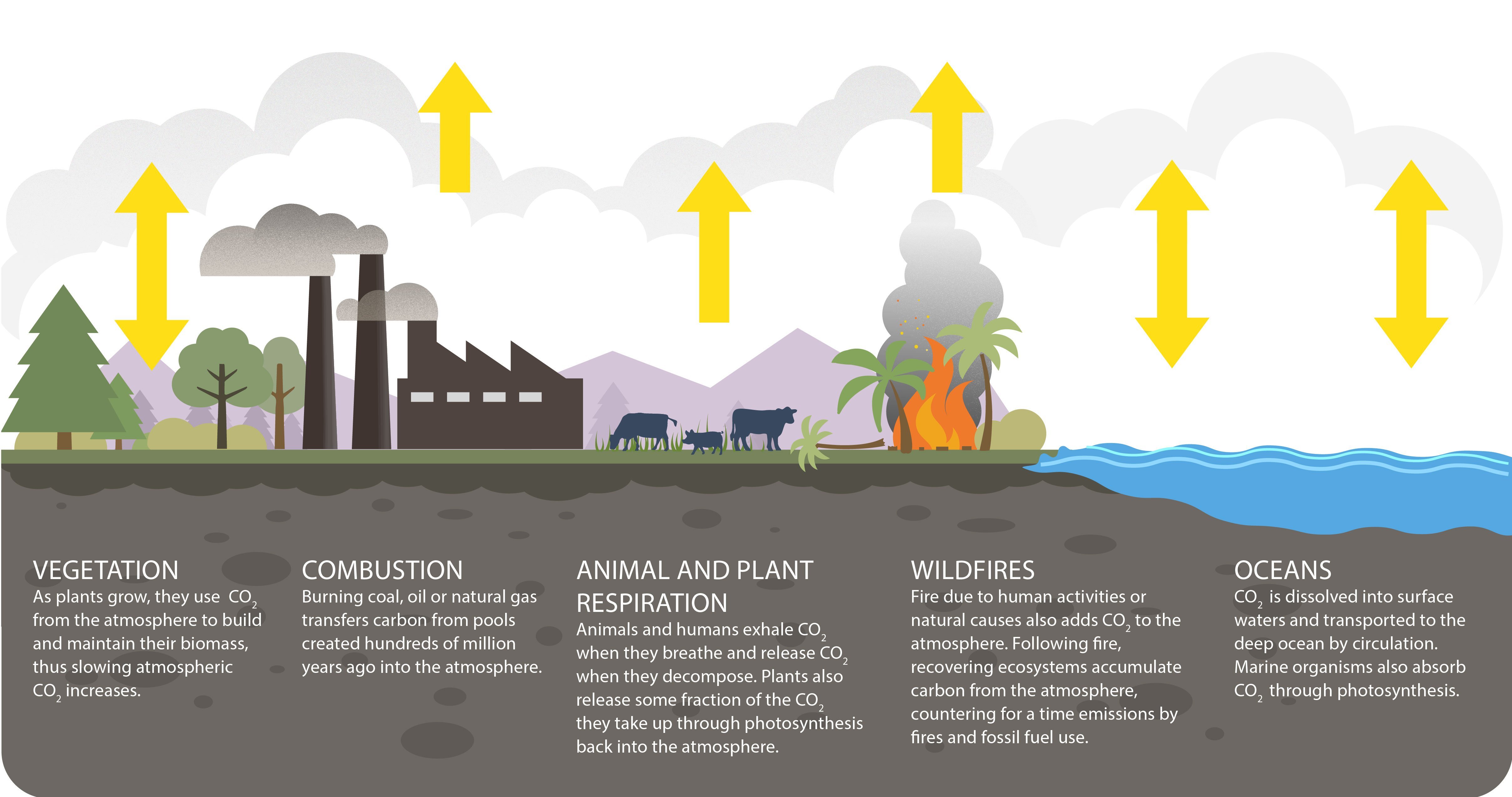
The Earth system maintains a natural balance of CO₂ through the carbon cycle, governed by sources and sinks. Sources are processes that release CO₂ into the atmosphere, including plant and animal decay, deforestation, respiration, and the burning of fossil fuels such as coal, oil, and gas. Sinks, on the other hand, remove CO₂ from the atmosphere—most notably through photosynthesis in vegetation and uptake by the oceans.
However, the strength, variability, and geographic distribution of these sinks—especially those that absorb roughly half of human-produced CO₂—remain poorly constrained. This raises critical questions: Will the efficiency of natural sinks decline in the future, accelerating the buildup of atmospheric CO₂? By how much? And can these sinks be managed or enhanced to help mitigate climate change? Improving our understanding of where and how these sinks operate is essential for predicting future CO₂ levels and their impacts on climate.
Because SIF is directly linked to photosynthetic activity, it provides a near-real-time indicator of how actively plants are growing and taking up CO₂. This makes it especially valuable for tracking seasonal growth cycles, detecting stress from drought or heat before visible changes occur, and assessing the overall productivity of ecosystems. By observing SIF across different regions and time periods, scientists can better understand how vegetation responds to environmental changes and how these responses influence the global carbon cycle.