
Orbiting Carbon Observatory-2OCO-2
OCO-2 does not measure carbon dioxide (CO2) directly. Instead, it measures the intensity of sunlight reflected from Earth's surface after passing through the atmosphere. Because CO2 and other gas molecules absorb light energy at very specific wavelengths, their presence leaves a characteristic spectral "fingerprint" that the instrument can detect and quantify.
To read that fingerprint, OCO-2 uses three high-resolution grating spectrometers. Each spectrometer is dedicated to one narrow wavelength band: one targeting a weak CO2 absorption band, one targeting a strong CO2 absorption band, and one targeting molecular oxygen (O2). The oxygen measurement serves as a reference, allowing the science team to precisely characterize the column of air the light passed through and convert absorption measurements into an accurate CO2 column abundance.
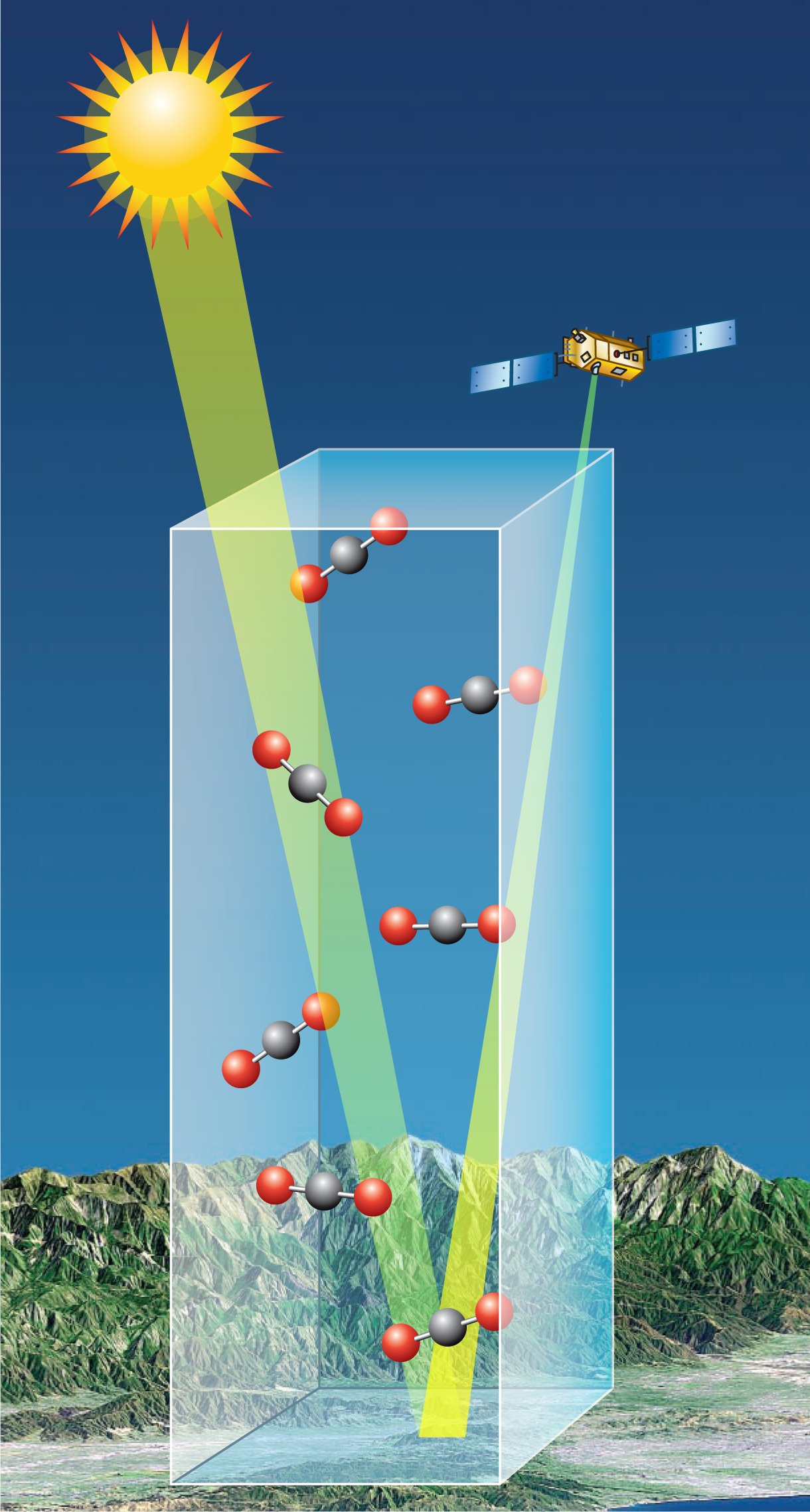
OCO-2 Measurement of CO2
The core optical element in each spectrometer is a reflection diffraction grating: a very flat surface etched with a regularly-spaced series of microscopic grooves that spread incoming light into its component wavelengths, much like the back of a compact disc. OCO-2's gratings are exceptionally fine: the instrument resolves 17,500 distinct color channels across the wavelength range visible to the human eye, compared to just three colors in a digital camera. This resolution is essential because CO2 absorption features can shift from nearly transparent to nearly opaque over extremely small changes in wavelength.
Sunlight enters each spectrometer after traveling from the Sun to Earth's surface and reflecting back up to the spacecraft, passing through the atmosphere twice. To detect the faint absorption signals against background noise, the light detectors in each spectrometer must be kept extremely cold. An onboard cryocooler (essentially a miniaturized refrigeration unit) maintains detector temperatures at approximately -120 °C (-184 °F).

Example of diffraction grating
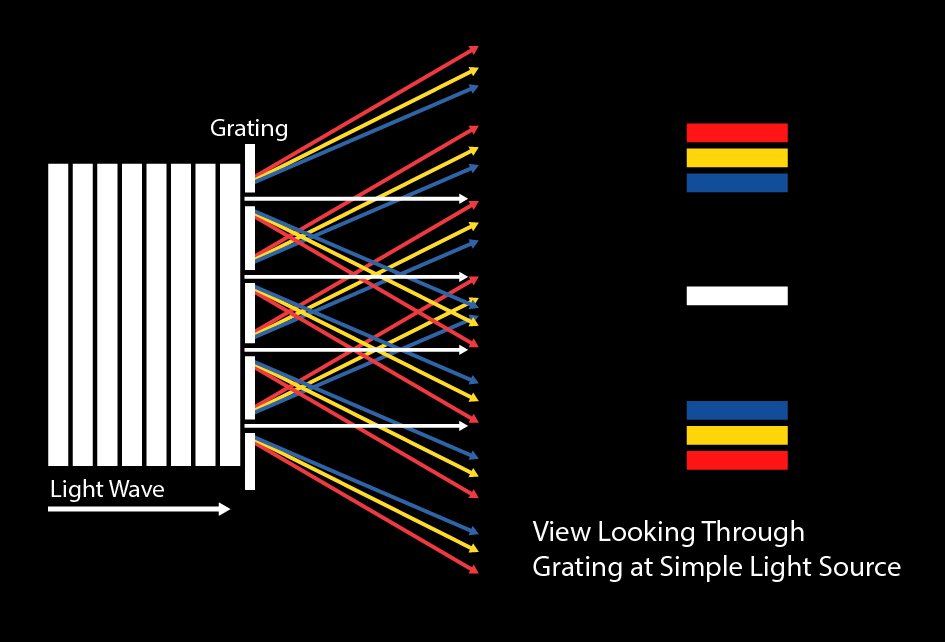
How diffraction works