
Orbiting Carbon Observatory-2OCO-2
Year: 2024 - 2026 | 2023 | 2022 | 2020-2021
December 16, 2021
Brendan Byrne and co-authors combined observations from multiple satellites, including OCO-2, to quantify the disruption to the carbon cycle due to drought and bushfires in southeast Australia during 2019–2020. The drought and bushfires resulted in a carbon loss from these ecosystems that is greater than Australia's annual fossil fuel emissions, although the carbon is expected to be drawn back into these ecosystems as the forests recover. Please see here: The Carbon Cycle of Southeast Australia During 2019–2020: Drought, Fires, and Subsequent Recovery
December 13, 2021
The AGU 2021 Meeting is in full swing this week.
November 11, 2021
The annual OCO-2 End of Year Review for 2021 concluded after reviewing all aspects of the project and the performance trends of the observatory and instrument. Overall, the hardware is performing well and we look forward to many more years of continued successful science operations and acquiring high quality data to support advances in carbon cycle science.
November 4, 2021
Members of our Science Team, including Dave Crisp (OCO-2/OCO-3 Science Team Lead), are participating in the COP26 Climate Summit this week. The team’s work on the Global Stocktake, a provision in the Paris accords that calls for reviewing the state of global emissions every 5 years, is referenced in the following News article in Science this week: On eve of climate summit, researchers sharpen emissions tracking
October 27, 2021
Friday October 22 saw the final day of the OCO-2/3 Science Team Meeting. This was held virtually and was preceded by many breakout sessions to cover all aspects of the Project and Science Team’s research and work, and 4 days of full plenary meetings. Over 160 people registered for the meeting. Participants showed great interest and joined in discussions on the progress and new research directions being presented. As the relatively new V10 data from both OCO-2 and OCO-3 are being more widely used by the community, new aspects of the carbon cycle are being studied. https://disc.gsfc.nasa.gov/datasets?page=1&source=OCO-2%20OCO-2
October 20, 2021
The virtual OCO-2/OCO-3 Science Team Meeting is in full swing this week.
October 14, 2021
It is more or less now well known that the OCO-2 observations can be used to detect the small solar induced chlorophyll fluorescence signals from plants, but in the analysis of these signals, Kohler and co-authors report an even smaller signal can be detected over barren surfaces from the luminescence of minerals. They found the signal over around 10% of barren surfaces and likely associated with the presence of trace amounts of Mn2+ in minerals. Please see here: Mineral Luminescence Observed From Space
October 6, 2021
Breakout sessions are underway this week in preparation for the Fall OCO-2/OCO-3 Science Team Meeting, to be held October 19-22, 2021.
September 22, 2021
A new study by Chevallier utilizes OCO-2 observations in “fast track” CO2 flux inversions, making use of the fact that satellite products are available faster than the surface observations that are generally used as reference. This study highlights the potential for OCO-2 (and future satellite datasets) to enable quasi-near-real-time estimation of CO2 fluxes that can be used to directly inform CO2 flux accounting for managed lands in large countries or groups of countries. Please see here: Fluxes of Carbon Dioxide From Managed Ecosystems Estimated by National Inventories Compared to Atmospheric Inverse Modeling
September 8, 2021
The role of OCO-2 measurements of CO2 and SIF in expanding observational capacity and providing sustained measurements of key climate variables is highlighted in the recently released Intergovernmental Panel on Climate Change Sixth Assessment Report (IPCC AR6). This report provides a scientific basis for governments at all levels to develop climate related policies. The full report can be found here: IPCC Sixth Assessment Report
September 3, 2021
Zichong Chen and co-authors use OCO-2 observations to quantify relationships between patterns in atmospheric CO2 and environmental drivers of CO2 fluxes, such as temperature, precipitation and availability of sunlight. The observed relationships are compared with those generated using 15 different terrestrial biosphere models. This work demonstrates the potential for using spaceborne observations to inform key relationships that are currently very uncertain in models. Linking global terrestrial CO2 fluxes and environmental drivers: inferences from the Orbiting Carbon Observatory 2 satellite and terrestrial biospheric models
September 2, 2021
The synergistic use of different satellite data is an important feature of the paper by Xing Li and co-authors, coupling SMAP soil moisture with OCO-2 solar induced fluorescence to study the impact of the 2018 drought in the United States. The satellite data revealed the impact of the drought on plant productivity and provided good estimates of crop yield. Please see here: Synergistic use of SMAP and OCO-2 data in assessing the responses of ecosystem productivity to the 2018 U.S. drought
August 19, 2021
Qinwei Zhang and co-authors describe a method of combining regional scale models and OCO-2 data in flux inversions to recover CO2 emission hotspots over continental north America, coincident with major urban centers. This and other techniques may provide new “top-down” information useful to support the next global stock take. Please se here: CO2 Flux over the Contiguous United States in 2016 Inverted by WRF-Chem/DART from OCO-2 XCO2 Retrievals
August 4, 2021
In a new analysis of OCO-3 data, with comparison to a baseline of OCO-2 observations, Raychaudhuri and Roy show that even over a short timescale, OCO-3 XCO2 can be used to detect the impact of the COVID-19 pandemic in the reduction of CO2 emissions in nine heavily populated urban regions around the world (note: this publication is an early release). Please see here: A Proof of Concept for Estimating the Annual Atmospheric Carbon Dioxide Variation From Orbiting Carbon Observatory-3 vEarly Data
July 27, 2021
Hu and co-authors use OCO-2 XCO2 measurements to estimate emissions for two coal-fired power plants in China, providing an example of the potential for satellite monitoring of large point sources. Please see here: Estimating CO2 Emissions from Large Scale Coal-Fired Power Plants Using OCO-2 Observations and Emission Inventories
July 1, 2021
Schuh and co-authors introduce a multi-scale modeling framework that provides a key step towards utilization of high resolution greenhouse gas datasets for monitoring urban CO2 emissions. This framework provides a means to account for atmospheric signals from sources and sinks outside the area of interest when quantifying emissions from urban areas. The team utilize estimates of natural and anthropogenic CO2 fluxes from the OCO-2 Model Intercomparison Project in their model simulations. Please see here: Far-field biogenic and anthropogenic emissions as a dominant source of variability in local urban carbon budgets: A global high-resolution model study with implications for satellite remote sensing
June 23, 2021
Jiao et al. have utilized OCO-2 solar induced fluorescence measurements to evaluate the robustness of relationships between vegetation growth and water availability in the extratropical Northern Hemisphere. Their findings suggest that vegetation is becoming more susceptible to drought over time. Please see here: Observed increasing water constraint on vegetation growth over the last three decades
June 17, 2021
Russell Doughty and co-authors utilize OCO-2 SIF retrievals and the v8 SIF Lite data product to examine the changes and anomalies to greenness, SIF and photosynthesis during dry seasons, El Niño and La Niña events in the Amazon Basin 2007-2017. Please see here: Small anomalies in dry-season greenness and chlorophyll fluorescence for Amazon moist tropical forests during El Niño and La Niña
June 16, 2021
Many OCO-2 science team members are participating in the 17th IWGGMS this week. For workshop meeting information, please see here: The 17th International Workshop on Greenhouse Gas Measurements from Space
June 9, 2021
We would like to give a mighty shout-out and thank you to TCCON for supporting OCO-2 as the vital ground-based resource for our data validation! The TCCON/COCCON virtual meeting is happening this week, June 8th-10th. For more meeting information, please see here: TCCON/COCCON 2021 Virtual Meeting
May 27, 2021
OCO-2 solar induced fluorescence has been used to confirm model predictions anomalous gross primary productivity (GPP, or the amount of carbon fixed by the ecosystem during photosynthesis) associated with the Indian Ocean Dipole (IOD) in 2019. The IOD, a major climate variability in the tropics associated with heavy rain and severe droughts, is predicted to occur more frequently in future warming scenarios but has so far not been well studied in terms of impacts on the carbon cycle. This study provides valuable new insights into the role of the IOD in regional and global carbon cycle interannual variability. Please see: Modulation of Land Photosynthesis by the Indian Ocean Dipole: Satellite-Based Observations and CMIP6 Future Projections
May 19th, 2021
The sister instrument to OCO-2, the OCO-3 instrument mounted on the International Space Station, can scan over larger areas to create Snapshot Area Maps. Observations in this mode over Los Angeles reveal intra-urban variations of XCO2 over the city that have never been observed from space before. The spatial variations are mainly driven by the complex fossil fuel emission patterns and meteorological conditions in the LA Basin and are in good agreement with those from co-located TROPOMI measurements of nitrogen dioxide (NO2), a co-emitted pollutant. Please see: Urban-focused satellite CO2 observations from the Orbiting Carbon Observatory-3: A first look at the Los Angeles megacity
May 6, 2021
OCO-2 data for a 5 year period has been used to test the understanding of the key processes that determine year-to-year differences in uptake (or release) of carbon dioxide in different in different regions. Zichong Chen and co-authors show that the data supports as large role in the tropics for grasslands, savannah, and agriculture as the forested areas. This is not well represented in magnitude in many models describing the behavior of these terrestrial ecosystems. Please see: Five years of variability in the global carbon cycle: comparing an estimate from the Orbiting Carbon Observatory-2 and process-based models
May 4, 2021
In celebration of the Crew-2 launch broadcast and Earth Day, Annmarie Eldering (Deputy Project Scientist for OCO-2, Project Scientist for OCO-3), gave a brief interview on Friday, April 23, 2021. This Teams interview was hosted by The International Space Station Program Research Office. Please see video here:
April 28, 2021
NASA has announced results and selections from the latest round of OCO-2/3 Science Team ROSES proposals. We want to welcome new and returning Science Team members (listed below). For more details, please see: NASA Science Mission Directorate Research Opportunities in Space and Earth Sciences–2020 NNH20ZDA001N-OCOST A.51 Science Team for the OCO Missions.
International team members:
April 28, 2021
The Amazon basin has been thought of as the “lungs of the planet” and a reliable carbon sink. Since 2017, researchers have found increasing evidence that anthropogenic practices have decreased the basin’s ability to capture carbon. Using OCO-2 and AIRS data, Jiang and co-authors show that the basin, during the dry/fire season (August through October), is a net carbon source, with elevated CO2 concentrations in the basin compared to the surrounding region. Please see: Impact of Amazonian Fires on Atmospheric CO2
April 22, 2021
Happy Earth Day! We are celebrating with a new launch to the ISS. Check out the SpaceX interview video with Dr. Annmarie Eldering in 'Galleries'.
April 13, 2021
With the continuing interest in understanding the relationship between solar induced fluorescence (SIF) and gross primary productivity (GPP), as an important measure of ecosystem activity, Yu Bai and co-authors use machine-learning methods to explore the relationship together with other auxiliary data sets. Please see: Estimating Global Gross Primary Production from Sun-Induced Chlorophyll Fluorescence Data and Auxiliary Information Using Machine Learning Methods
April 1, 2021
The Hayoung Park and co-authors use OCO-2 CO2 together with S-5P TROPOMI CO and NO2 measurements to study regional emission characteristics of different cities, and consider which factors may influence the relationship between CO2 and air pollutants. Although the observations span just 15 months, the authors consider how sustained observations might inform strategies for mitigating climate and air pollution. Please see: An assessment of emission characteristics of Northern Hemisphere cities using spaceborne observations of CO2, CO, and NO2
March 24, 2021
The OCO-2/3 missions successfully completed the virtual science team meeting March 15-18, 2021. Please keep in mind that the next meeting is scheduled for October 18-22, 2021.

September 21, 2020
The OCO-2/OCO-3 missions will have a virtual science team meeting October 19-23, 2020! Breakout sessions begin 9/28 through 10/15. Please check out the breakout plan and further details on the main site.
We will certainly miss seeing everyone in beautiful Boulder, but looking forward to seeing your friendly faces online. For more information, please visit the links below. If you have additional questions, please reach out to Dr. Annmarie Eldering, annmarie.eldering@jpl.nasa.gov.
Main page: https://sites.google.com/view/oco2oco3stm1020/home
iPoster sign up: https://sites.google.com/view/oco2oco3stm1020/iposter-signup
August 12, 2020
The “official” OCO-2 v10r L2 FP, L2 Diagnostic, L2 XCO2 Lite, and SIF Lite products are now posted on the GES DISC for global access: Click Here.
The current products are the reprocessed results of the entire OCO-2 data record, extending across the entire mission from 2014-09-06 to 2020-07-30. These results supersede and should replace the v10r beta products distributed earlier for internal review.
For more details, please click here.
July 28, 2020
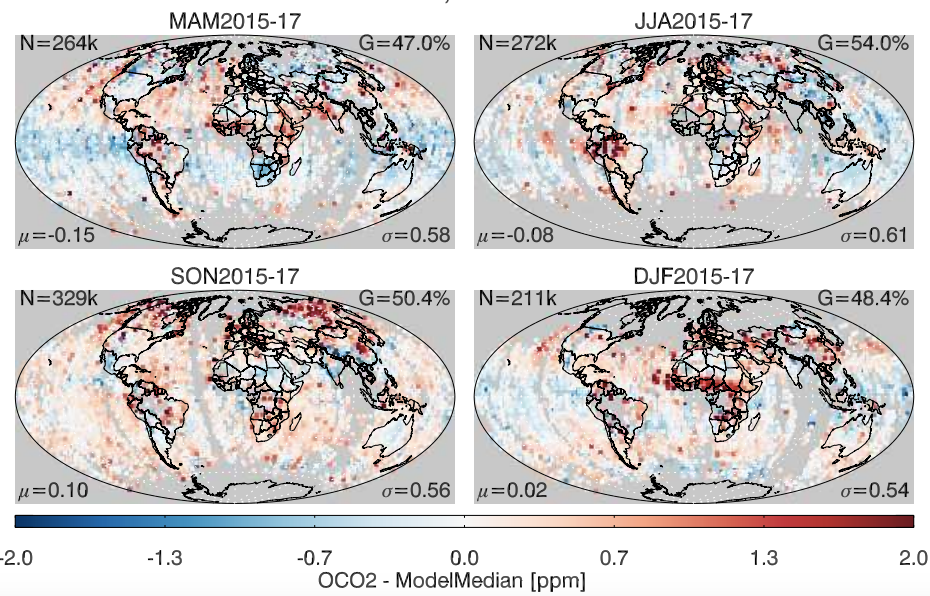
Over the last few months, OCO-2 has been finishing the reprocessing of the entire OCO-2 data record (2014 to present). This new version, version 10 or V10, reflects updates to the data processing software to "improve the quality of the now five and three-quarter year record of atmospheric Carbon Dioxide (XCO2) and Solar Induced Chlorophyll Fluorescence (SIF)". There will be an announcement in August at the GES DISC when the whole data set is available with supporting documentation to describe how to use the data. Please learn more here.