
Orbiting Carbon Observatory-2OCO-2
Year: 2024 - 2026 | 2023 | 2022 | 2020-2021
December 8, 2022
A new study by Nassar and co-authors uses OCO-2 and OCO-3 observations to demonstrate spaceborne capability for tracking power plant emissions in close to real time. The full scientific article can be accessed here: Tracking CO2 emission reductions from space: A case study at Europe’s largest fossil fuel power plant.
September 26, 2022
Cressie and co-authors apply a new analysis technique to CO2 flux estimates from the OCO-2 Model Intercomparison Project (MIP) to obtain a statistically optimal consensus result from model output from 9 different teams. This technique allows for weightings that account for common features between models as well as the quality of numerical approximations used within the models. The end result is a more precise and informed consensus on CO2 fluxes than a simple weighted average of results. See full article here: From Many to One: Consensus Inference in a MIP
September 19, 2022
A new story spotlights Brendan Byrne’s research using OCO-2 data: National CO2 Budgets informed by atmospheric CO2 measurements. He is also a co-author of the paper, National CO2 budgets (2015–2020) inferred from atmospheric CO2 observations in support of the Global Stocktake, which is currently under review (comments are invited).
September 8, 2022
Villalobos and co-authors have used OCO-2 measurements to quantify interannual variability in the carbon cycle over Australia and relate the fluctuations to anomalies in vegetation productivity and climate drivers such as precipitation and temperature. This study demonstrates the utility of the multi-year OCO-2 record in evaluating carbon-climate feedbacks on regional scales. See full article here: Interannual variability in the Australian carbon cycle over 2015–2019, based on assimilation of Orbiting Carbon Observatory-2 (OCO-2) satellite data
August 25, 2022
Kang and co-authors have applied a neural approach to downscale the Global OCO-2 SIF (GOSIF) product to the spatial resolution of cotton field parcels. The downscaled SIF estimates were then used to evaluate the feasibility of estimating cotton yields at the field scale. The study demonstrates promise for using satellite SIF products as a basis for estimating agricultural yield on small spatial scales. See full article here: Downscaling solar-induced chlorophyll fluorescence for field-scale cotton yield estimation by a two-step convolutional neural network
August 17, 2022
August 6th marked the 8th anniversary of OCO-2's 'first light' spectra!
A new article covering OCO-2's measurements of CO2 from forest fires can be found here: NASA satellite captures rising carbon dioxide after major forest fires
August 3, 2022
In Mysteries of the Global Carbon Cycle, Dave Crisp and co-authors provide a high level summary of their recently published article describing the natural processes that drive the global carbon cycle. For the full article, please see here: How Well Do We Understand the Land-Ocean-Atmosphere Carbon Cycle?
July 12, 2022
The 18th IWGGMS Meeting is in full swing this week, July 12-14, 2022 (online).
June 22, 2022
Qiu and coauthors have used the GOSIF product (based on OCO-2 measurements of solar induced fluorescence) to evaluate impacts of the 2012 drought on crop yields for corn and soybeans in the U.S. Midwest. Their results show that crop yield anomalies are extremely well correlated with GOSIF anomalies, demonstrating the potential of satellite-based products for monitoring the responses of crop productivity to drought. See full article here: Monitoring drought impacts on crop productivity of the U.S. Midwest with solar-induced fluorescence: GOSIF outperforms GOME-2 SIF and MODIS NDVI, EVI, and NIRv
June 9, 2022
Chevallier and co-authors have applied a simple emissions estimation scheme to OCO-2 and OCO-3 XCO2 measurements over hundreds of large point sources and urban areas over multiple years. They show that OCO-2 and OCO-3 provide robust trends in emission estimates. In addition, OCO-3 cases display a consistent increase in emissions from morning plumes to afternoon plumes, highlighting its ability to capture the diurnal component of emission estimates. See full article here: Large CO2 Emitters as Seen From Satellite: Comparison to a Gridded Global Emission Inventory
May 20, 2022
The NASA Applied Remote Sensing Training Program (ARSET) is currently offering two training courses related to using OCO-2 data. ARSET courses are conducted online at no cost to the participant.
May 2 2022
Check out NASA JPL’s new documentary “Sky High” that includes the OCO-2 origin story. Learn about the highs, lows, and surprises that come with developing space missions.
March 30 2022
David Crisp highlighted the OCO-2 satellite's pioneering efforts in CO2 measurements from space while speaking as a panelist to the White House committee on science and technology. See full article here: JPL Scientist Speaks with White House Committee
March 23 2022
A new video spotlighting OCO-2 and CO2 measurement results during the pandemic is available here: Climate Change and the Pandemic
March 15 2022
'Lan Dang works on the Orbiting Carbon Observatory-2 and Orbiting Carbon Observatory-3 satellites as the Science Data System Lead. When she’s not busy handling the data the satellite sends back, she’s pursuing her other passion: mentoring new hires and local schoolkids.' To read the full interview with Lan, please see here: Spotlight on Lan Dang: Mentoring the next generation
March 9 2022
The hybrid OCO-2/OCO-3 Science Team Meeting will occur next week, March 15 - 17, 2022, 10am - 2pm PST.
March 2, 2022
Sheng and co-authors present a new gridded, long-term XCO2 dataset (Mapping-XCO2) using the XCO2 retrievals from GOSAT and OCO-2 during the period from April 2009 to December 2020, using a geostatistical approach to fill data gaps. The authors suggest that this dataset can be used to investigate XCO2 variations at global and regional scales and to evaluate anthropogenic CO2 emissions and ecological CO2 fluxes. Please see full article here: Global land 1° mapping dataset of XCO2 from satellite observations of GOSAT and OCO-2 from 2009 to 2020
February 23, 2022
"Observing your community can depend greatly on your perspective. A science teacher's dive into local carbon dioxide data provides a point of comparison for what NASA's carbon-monitoring satellite can reveal." To read Mejs Hasan's full article, please see here: Science From the Rooftops
February 17, 2022
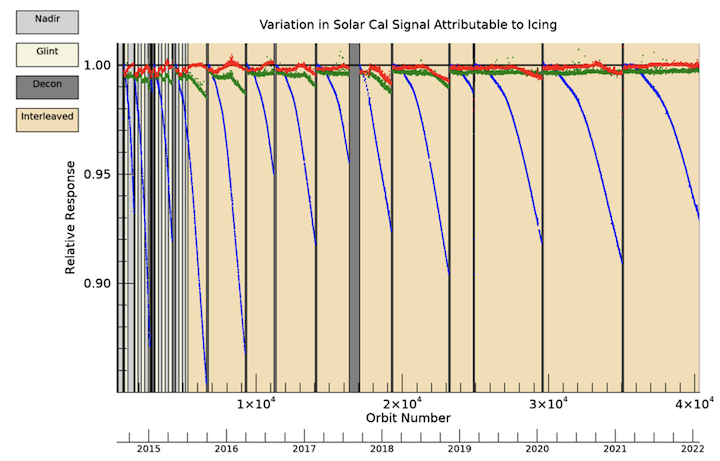
A planned decontamination cycle was initiated for the OCO-2 instrument on February 14, 2022. We expect to return to collecting science data in the later half of next week.
During the course of the mission, outgassing of tiny amounts of water vapor, left over from the time that the instrument was still on Earth, leads to accumulation of ice on our detectors, reducing the radiometric throughput. We can use our solar calibration measurements to keep an eye on the impact of this ice as it builds up over time, and we periodically warm up the instrument to avoid too much reduction in the detector response (see figure). As the mission progresses, the ice accumulation has slowed, and these decontamination/warm-ups are needed less frequently. In recent years, we have performed decontamination cycles approximately once per year.
February 10, 2022
Our Science Team are investigating signs of enhanced CO2 in plumes from the January 15th eruption of the Hunga Tonga-Hunga Ha‘apai volcano. Please see here: NASA/JPL satellite captures CO2 data from Tonga volcano
February 2, 2022
On January 20th, Dr. David Crisp gave an overview on "Estimating Carbon Dioxide and Methane Emissions from Space" at a meeting on "Improving Efforts to Measure and Monitor Greenhouse Gas Emissions" for the President’s Council of Advisors on Science and Technology (PCAST). A recording of the presentation can be found here:
President’s Council of Advisors on Science and Technology (PCAST) 2022 Meetings
January 18, 2022
Reductions in human activities in early 2020 due to COVID-19 pandemic led to unprecedented decreases in carbon dioxide (CO2) emissions from burning of fossil fuels. However, the impact of these emissions changes on atmospheric CO2 are small compared to year-to-year changes associated with atmospheric transport and biospheric fluxes, making it challenging to disentangle human-induced changes from natural variability. In a new study using OCO-2 observations of XCO2 together with an integrated Earth System model, Weir and co-authors show that the impact of these short-term, regional changes in fossil fuel emissions on CO2 concentrations was indeed observable from space, indicating that current spaceborne technologies are approaching the levels of accuracy and precision needed to support climate mitigation strategies. Please see here: Regional impacts of COVID-19 on carbon dioxide detected worldwide from space
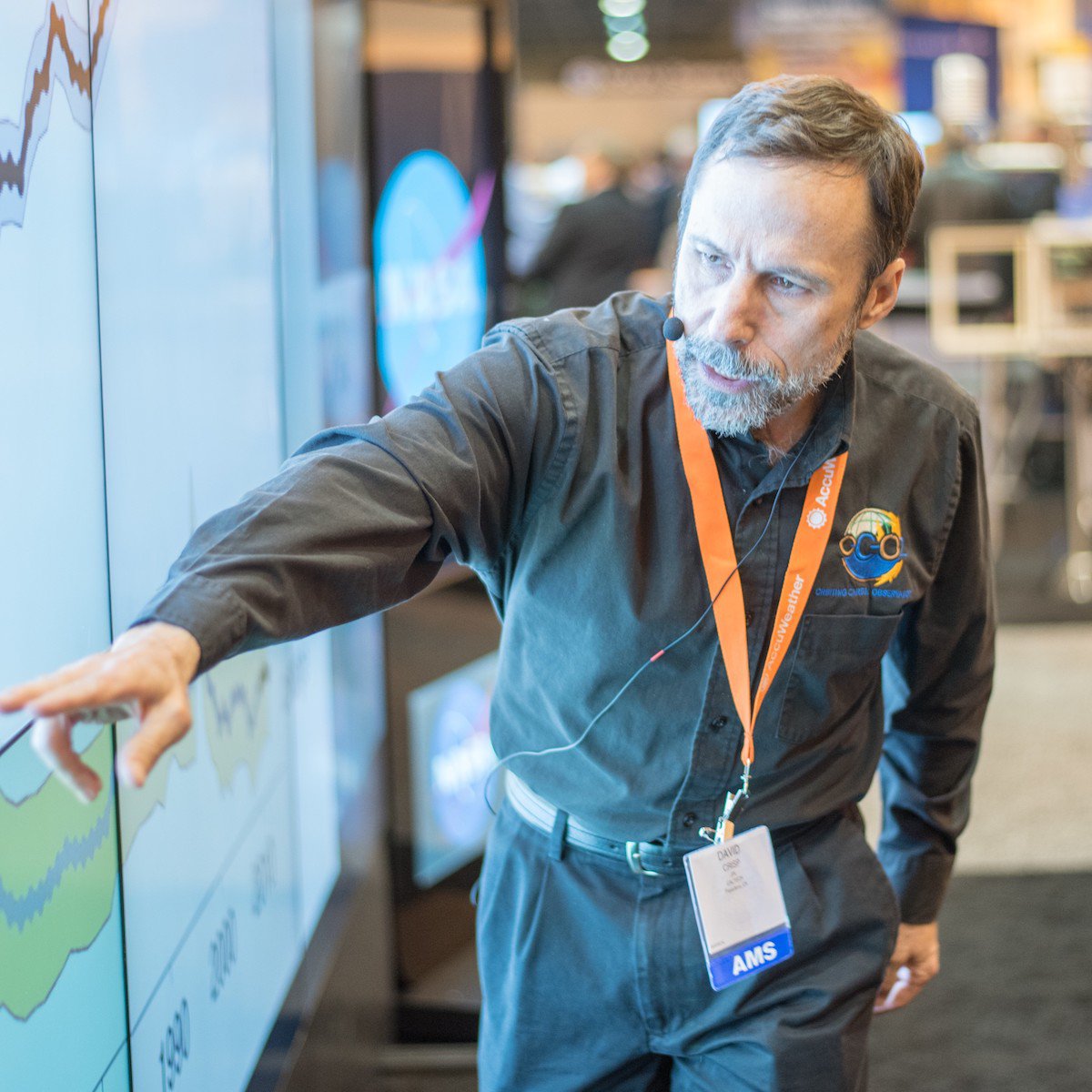
Image credit: NASA/JPL-Caltech
January 6, 2022
Dr. David Crisp, our illustrious OCO-2/OCO-3 Science Team Lead, will be retiring from JPL at the end of this week. We are incredibly grateful for his leadership and for the energy and enthusiasm he has imbued into so many different aspects of the OCO-2 and OCO-3 projects over the years. Thank you Dave!